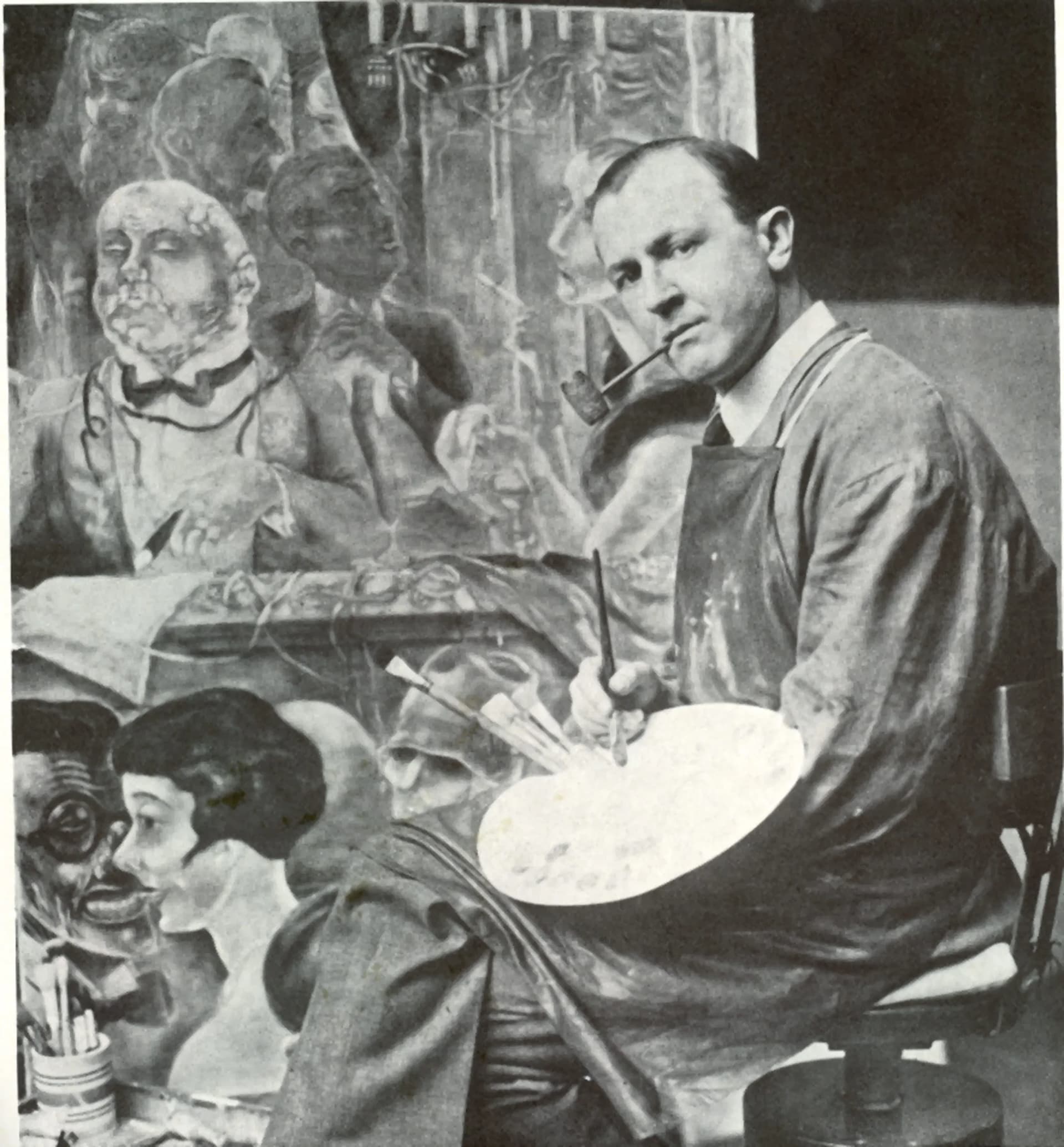
George Grosz was an ideologically committed painter, who started out as a caricature artist with a socially critical style that became more mordant as a result of the traumatic experience of World War I. Driven by his disillusionment with the society that surrounded him, he joined the Berlin Dadaist group and became the foremost practitioner of the Neue Sachlichkeit (New Objectivity). During the 1920s, Grosz's artistic style expressed his disgust with postwar Germany. The modern metropolis became the recurring theme of his work and, like a contemporary Bosch with an incisive critical tone and keen sense of observation, he captured his surrounding environment in works with a moralizing intent. He was perhaps the artist who provided the most reliable chronicle of Weimar Republic Germany.
Grosz's fame began to spread internationally and he was soon hailed as one of the leading German artists. He was invited to be a guest lecturer at the New York Art Students League in 1932. Following the advent to power of the National Socialist party in Germany, he settled permanently in the United States in 1933. During his American years, Grosz created landscapes, nudes, and highly political works he called "images of hell." In these works, Grosz gave up beauty for the sake of drastic imagery, conjuring up the end of civilization. He reacted with artistic rage to the torture and murder of his old friend Erich Mühsam by the Nazis and to the stories told by the writer Hans Borchardt after his release from a concentration camp. The longed-for end of the war brought with it the recognition that humanity was threatened with a nuclear apocalypse. The Stickmen, post-nuclear creatures without bodies, was Grosz's last major group of works, culminating in the haunting Painter of the Hole (1947). He bade farewell to America with a group of collages, a joyful return to a technique of the Berlin years: "You stay Dada all your life," he remarked. Grosz died in July 1959, only a few months after returning to Berlin.
George Grosz (b. 1983, Berlin, Germany – d. 1959, Berlin, Germany)
The Das Kleine Grosz Museum in Berlin is solely dedicated to Grosz's life and work. Solo exhibitions of Grosz's work have taken place at The Metropolitan Museum of Art, New York; The Heckscher Museum of Art, Huntington, NY; Dallas Museum of Art, TX; Staatsgalerie Stuttgart, Germany; Broehan Museum, Berlin; and The Arts Club of Chicago, among others.