Cath Campbell
About this work
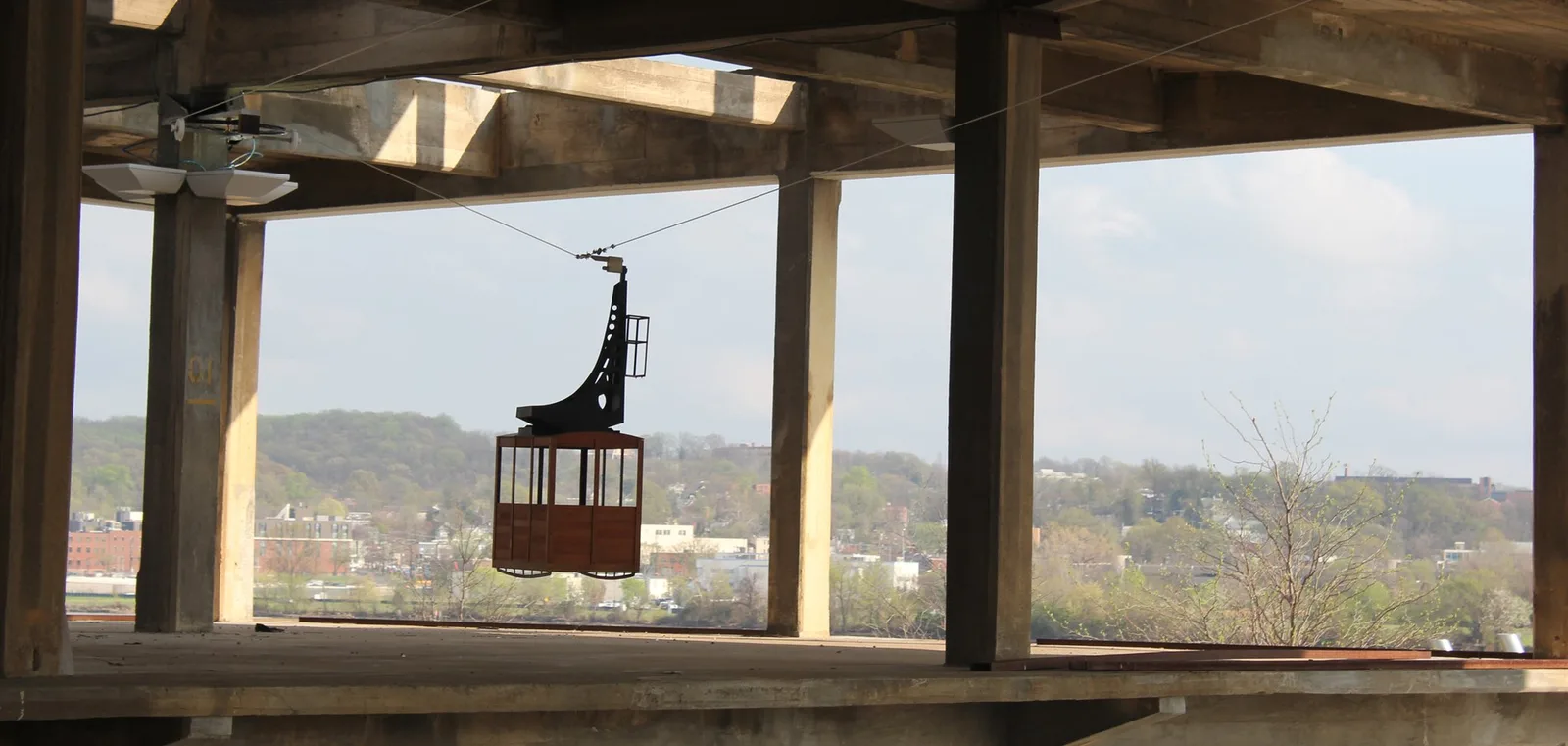
Has the world grown smaller by any chance? Matthew Hearn In the late hours every Sunday, Radio 4 broadcasts a weekly programme, Something Understood. Thematically considered, each episode of the programme details a journey in and around ideas, focusing on a particular theme via an expanded repertoire of music, poetry and prose. It is a response both poly-vocal and multi-dimensional, and its aim is less to define an answer than to open up a conversation. Having been asked to offer some thoughts on Cath Campbell’s recent installation, Marathon, it is my intention to attempt something of a similar order. Marathon was installed 3500 miles away, in a place neither I, nor – more importantly – the artist was able to visit. My experience of the work then, is a virtual one. * In the opening chapters of Jules Verne’s classic novel Around The World in Eighty Days, the scene is set for the ensuing tale of travel. The story that unfolds is itself a fiction whose underlying conditions – namely technological innovation and the consequent global possibilities for mechanised travel – mark an important historical shift reflected in the question: “Has the world grown smaller by any chance?”. In the novel, Ralph replies “of course it has… because you can go round it ten times more quickly than you could a hundred years ago” , but what we can perhaps more objectively state is that our perception of the scale of the world has indeed changed: in relative terms, it has become smaller; distances have grown to be all the less. In a number of ways Around The World in Eighty Days represented a sea–change in perceptions of travel (and travel writing) offering a blurring in the distinctions between a traveller typified by the former explorer or high adventurer seeking out distant lonely corners of the earth (recalled through prose laced with exotic boastfulness, one-upmanship and exclusivity) and the markers of modern-day global tourism in which these once exceptional destinations, and related accounts of experiences offered have become increasingly accessible and populist. In Verne’s novel, the catalyst that facilitates the possibility of this challenge is the announcement of the opening of the Great Indian Peninsular railway. For the present-day adventurer, time and space have been compressed and global interchange and exchange has become ubiquitous. We can be almost anywhere in the world in a matter of hours, or less. Distances that were once deemed expedition-worthy are now covered by a medley of short and long-haul flights, and what were once grand passages have been shrunk to regular commutes. Whilst tourism suggests a physical relationship with, and experience of, places, via the virtual arena we too can travel the globe. By virtue of cellular networks, fibre-optic cables and satellite communications we can now be in two places at once: from the comfort of our living room we can be looking out to sea and surveying the surf in Cornwall via a webcam; our computers can enable virtual tours of hotels, worldwide; we can share ‘FaceTime’ and space with a friend using our ever-present mobile phones and we can collectively convene in the virtual arena of a chat-room or Skype conference. We can document every moment with precision and detail, enabling both ourselves and others to re-live the events after the fact as well. In short, we have the option to live the travelled experience (or at least recreate its intimacy) without travelling the physical distance. Herein lies an important distinction: we are no longer constricted by the necessity, or the inability, to travel. As noted earlier, Cath Campbell has never been to Washington DC – at least she hasn’t physically travelled that magnificent distance. Nonetheless the work that she has produced for the former lumber shed in Yards Park harnesses a very particular sense of specificity observed and researched from far-away Newcastle. Conducted from afar, Campbell’s research journey has taken detours via various signifiers – even briefly surfacing as far away as Japan – and yet the work that she has created has married her particular aesthetic and interests with elements from its site, making Marathon a work conceived of and for the wider-context of Washington DC. In its most basic sense Marathon is a working scale-model of a cable car running continuously backwards and forwards traversing the geometric shell of an architectural expanse that is, or at least was, a lumber shed. The shed – now only in name – offers an in-between space: neither a place of origin, nor a final destination, but a locus of continuous passage of time and purpose. Within this shell Campbell has in turn chosen to locate – or more accurately dislocate – a similarly de-functionalised object: a sculpture which is at once both a credible interpretation and impotent rendering of a cable car. Within the installation the model moves with purpose and intent, and yet travels nowhere, takes nobody to or from one place or another, only symbolises the movement of travel through its itinerant roaming. Once a site of labour and industry, the Lumbershed and the surrounding parkland is in the process of transition, slowly becoming enlisted in the services of other kinds of industry, that of enterprise, recreation and tourism. Placed in the context of such, Marathon’s slow persistent movement becomes a metaphor for the dogged determination of social and physical mobility, and the nomadic status which architectural space both governs, and is given. In the mid 1980s, artist Robert Irwin sought to add some definition to ideas surrounding sculpture and its relationship to its placement within the public sphere . In this ‘roughing-out’ of ideas, Irwin proposed a series of four categories by means of which we might interpret particular works and their corresponding relationship to the site of placement. Considering Marathon with respect to these distinctions, it is not as simple as to say it sits comfortably within a single category, yet focusing on certain conditions or aspects proves useful in defining the work and its various relationships. For example, under the heading ‘Site Adjusted’, Irwin notes “consideration is given to adjustments of scale, appropriateness, placement etc. But the ‘work of art’ is still either made or conceived in the studio and transported to, or assembled on, the site.” Whereas under the category ‘Site conditioned/determined’ Irwin states “here the sculptural response draws all of its cues (reasons for being) from its surroundings” . As a commissioned work, conceived as part of the 5x5 festival, Marathon is simultaneously determined by the conditions and parameters of the wider project, yet aspects of the “understanding of the ‘work of art” are still “keyed (referenced) to the oeuvre of the artist”. Put another way circumstance governs the real context of the works being in the world: “what was, how it came to be, what it is, and what it may come to be” . * Travel in itself can be both a pleasure and a chore, a necessity or a luxury, a burden when experienced in excess and a restraint when one is unable to even entertain the possibility of it. Its prevalence within Campbell’s more recent practice can arguably be read as a reflection of the short-term limitations imposed by the responsibilities of family life. The press release accompanying her recent exhibition described travel guides as ‘golden tickets’ enabling a personal projection of oneself onto foreign soils. It appears in one sense that the escapism implicit in travel becomes the draw, and the unattainable attraction for Campbell. In another recent body of photographic works, Campbell has interrogated the structural devices by means of which travel guides are assembled: the cool patina of superficiality; the sense of style which is both part of their appeal and yet symptomatic of their disassociation from reality; the artificiality. In one sense Campbell is critical of the formulaic composition of these guides, of the familiar yet limited colour palettes, the contrived architectural interior and exterior photography in which the clutter of humanity has been ruthlessly obliterated leaving an empty space to insert oneself. The guides nonetheless manufacture a fictionalised and synthesised account of experiences to be consumed in manageable pieces. They make available an aspect of a city that can be afforded a glance, and additionally offer an itinerary by means of which one can partake of the best parts of the city in the (imaginary) time and space of a 24–hour period. More superficial in editorial tone than the classic Baedeker guides of the early to mid-twentieth century – so relied upon for an authoritative voice and ‘qualified’ interpretation – for the landlocked sailor, the grounded pilot or otherwise immobilised traveler, the precise edited schedule of the travel guide nonetheless offers a virtual escape. This appeal is not lost on Campbell, in spite of her guarded reluctance to let go. As part of one ongoing series of images , And We Said Nothing All Day (2011-) Campbell has produced a series of snapshots of photographs in guidebooks. These low-grade facsimiles of second-hand imagery reflect a doomed attempt to claim these experiences as one’s own. In certain images, the reflection of a flash or even a glimpse of the artist is captured in the image, undermining any attempt to pass these images off as first-hand. Regardless, the images mix and match together cities and seasons into an incongruent medley in which neither the ‘authenticity’ of the original photograph, nor the assembled collection of ‘travel-snaps’ is able to hold up any semblance of legitimacy. Here we might draw a final comparison to Italo Calvino’s fictionalized travelogue, Invisible Cities. In Invisible Cities we, like Khan, are offered a series of concise narratives by Marco Polo of places he has purported to visit under the auspices of the Emperor. Unable to survey the vast expanses of his Empire himself, Kublai Khan relies on envoys to report back on the conditions in the distant stretches of his territories. In Calvino’s novel we are witness to Khan as a virtual-tourist, seeing only through the eyes of others, consuming Polo’s experiences and encounters as if they too – like the lands from which they are alleged to have originated – are his own. Though taken with the telling, Khan becomes disillusioned by all that he hears, and ultimately he becomes disenchanted by the very promise of travel. ‘I think you recognize cities better on the atlas than when you visit them in person’ Khan ultimately declares. Here, though Khan’s declaration is mis-directed, he reaches a similar conclusion to that played out through Campbell’s recent practice: he comes to question the inter-relationship between reality, desire and experience of an idealised world. 1)Jules Verne Around The World In 80 Days (1950) Ward, Lock & Co. Ltd., London, p. 16 2)Robert Irwin, ‘Being and Circumstance–Notes Towards a Confidential Art’ (1985) in Kristine Stiles and Peter Selz (eds.) Theories and Documents of Contemporary Art: A Sourcebook of Artists' Writings, University of California Press, Los Angeles, pp. 572-574 3)Ibid p. 572. 4)ibid p. 573. 5)In E M Forster’s, A Room With A View, (1990) Penguin, London the Baedeker is used as a metaphor for the repressed or received attitudes of Edwardian society and the unwillingness to form ones own opinions or question others. The loss of the book within the story becomes a symbol of liberation whereby Lucy Honeychurch is able to construct her opinions of her experiences. 6)These themes also formed the backbone to Campbell’s recent exhibition Ideal Mexico at WORKPLACE Gallery, 11th February – 17th March 2012. 7)Italo Calvino Invisible Cities (1997) Trans. William Weaver, Vantage, London, p. 137