Cath Campbell
About this work
'Canary yellow with royal blue' is an excerpt from a description of the location of Six Gallery, San Francisco, which in 1955 hosted a poetry reading by a group of radical West Coast writers, who later became known as the Beat Generation. For BALTIC 39 | FIGURE THREE the gallery becomes a stage set for a series of public readings of a poem from one of Caths films that refers to a journey across eight American states from Hawaii to Missouri.
The writing is taken from an ongoing collection of short films that map a series of fictional road trips across a dreamlike American landscape.
Made by collaging together clips from amateur travel videos found on YouTube, the dialogue in each clip is translated by Google automatic captions, and the resulting subtitles are full of slight mis-translations that provide a disquieting and poetic ambiguity to the narrative. Deliberately lo-fi in both their process and aesthetic, the clips are stitched together to create short film-poems that allude to the 'stream of consciousness' - a narrative device used by Jack Kerouac, one of the key figures of the Beat Generation - in which the writer attempts to remove rational thought, instead presenting an inner consciousness.
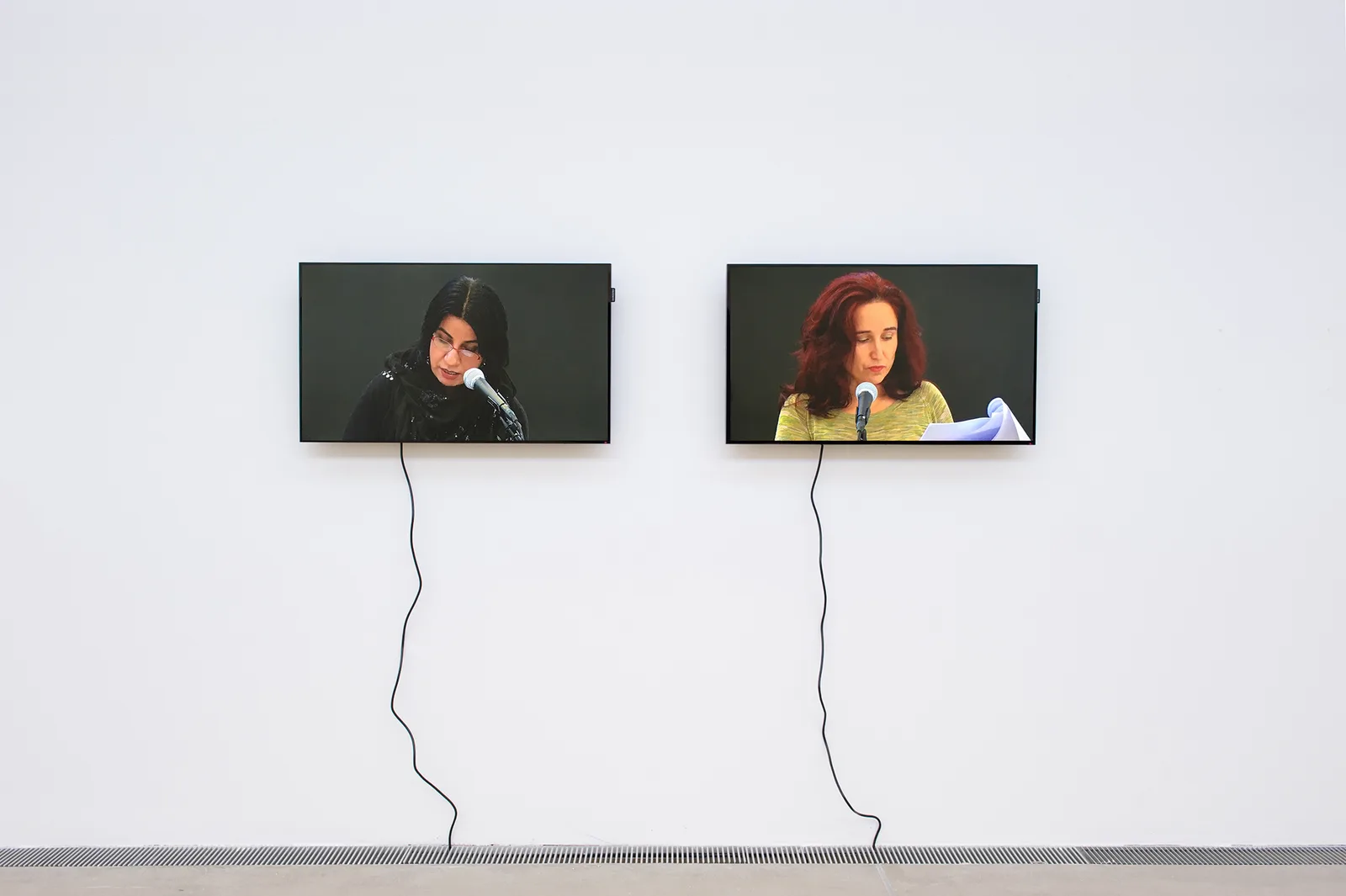
For her exhibition at BALTIC 39, five monumental black screens, each containing a line of text from the poem are used to disrupt and transform the space. The screens are re-arranged during the exhibition, altering the reading of the text, reconfiguring the audience's relationship to the architecture and providing a changing backdrop for the performances. Campbell has invited a number of women whose first language is not English to read the work. Each performance will be recorded and played back within the space throughout the course of the exhibition.
The choice of non-native English speakers brings disparate voices together within the gallery space, providing a space for sharing and collective action at the same time as exploring the nature of mistranslation, the political nuance of language, and the layers of separation between the beginning and end point of the poem’s narrative.