DOT DOT DOT DASH
21 November 2015 - 30 January 2016
The Old Post Office, Gateshead
- Venue
- The Old Post Office
- Date
- 21 November 2015 – 30 January 2016
Gateshead,
United Kingdom
A well-known Morse code rhythm from the Second World War period derives from Beethoven's Fifth Symphony, the opening phrase of which was regularly played at the beginning of BBC broadcasts. The timing of the notes corresponds to the Morse for "V"; di-di-di-dah and stood for "V for Victory" (as well as the Roman numeral for the number five). The V sign has various meanings, depending on the cultural context and how it is presented. It has been used to represent the letter “V” as in “victory". It is also used by people as an offensive gesture, and by many others simply to signal the number 2. Since the 1960s, when the “V sign” was widely adopted by the counterculture movement, it has come to be used as a symbol of peace. DOT DOT DOT DASH brings together work by five artists working across media whose individual enquiries deliberately tread a complex and polarized line in terms of subject, intention, and potential interpretation.
Jennifer Douglas’ recent paintings reference the found working environments of heavy and light industry and their equivalents within art history. Muted tones of industrial floor paint, all pervasive within the architectural modes of display that surround international contemporary art, create a tranquil and opaque surface on canvas. Douglas then repeatedly punctures and scratches the surface through sheets of carbon paper to make a constellation of marks that is both violent and painterly.
Joel Kyack’s performance Your Optimism Fills Graves took place at Workplace London in October 2015. Re-presented as video documentation with sculptural objects; Kyack’s work explores the hand of the maker through the use of traditional and non-traditional materials and processes. Clay, wax, plastic, ceramics, wood, power tools, pumps and liquids share a stage in the creation of sculptures, fountains, drawings, and sounds. Questions of individual agency are introduced, considered, transformed and destroyed, as a sea of options builds into a carefully constructed chaos.
Rachel Lancaster’s new paintings continue her interest in B Movies and in particular the recurring presence of Blobs. Isolated from their original contexts these strange forms act as an absurd stand-in for a human presence that is simultaneously sinister and comedic. Through careful economic representation in oil-paint Lancaster’s seductive paintings invite contemplation of fragments or moments within uncanny lifeless objects whose original function was to engage audience through the dark and surreal abstractions of the body and the malevolent.
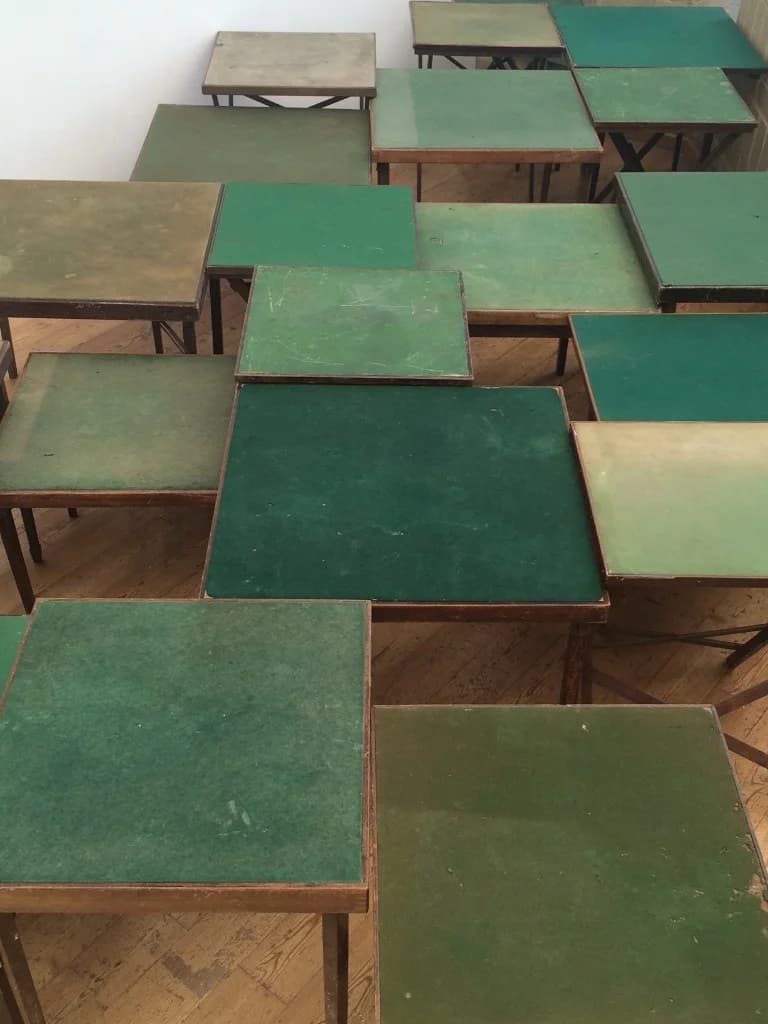
Paul Merrick combines painting with sculpture and the made with the ready-made. Investigating colour, materiality, and architectural and spatial arrangement in relationship to the history of Painting. Under The Line is an installation comprising of a series of used playing card tables arranged to create a horizontal plane of interconnecting accidental marks, tones, lines, and surfaces. Each weathered object invites speculation into what may have been won or lost through chance, a complex and anonymous metanarrative buried in a complex abstracted composition.
Mike Pratt’s series of headless, vibrating, bikers form a confrontational fleet in the gallery. Their frayed hair extensions (garnished with seashells and feathers) allow a non-verbal declaration towards the quintessential outsider, describing their characteristics through materiality. Pratt’s carefully selected worn out leather jackets hold a close relationship to painting, with each layered, graphic, surface revealing actions and incidents. Pratt’s objects are presented as portraits, emulating an experience whilst also allowing the push and pull of the making process to make space for his own intuitive remarks.