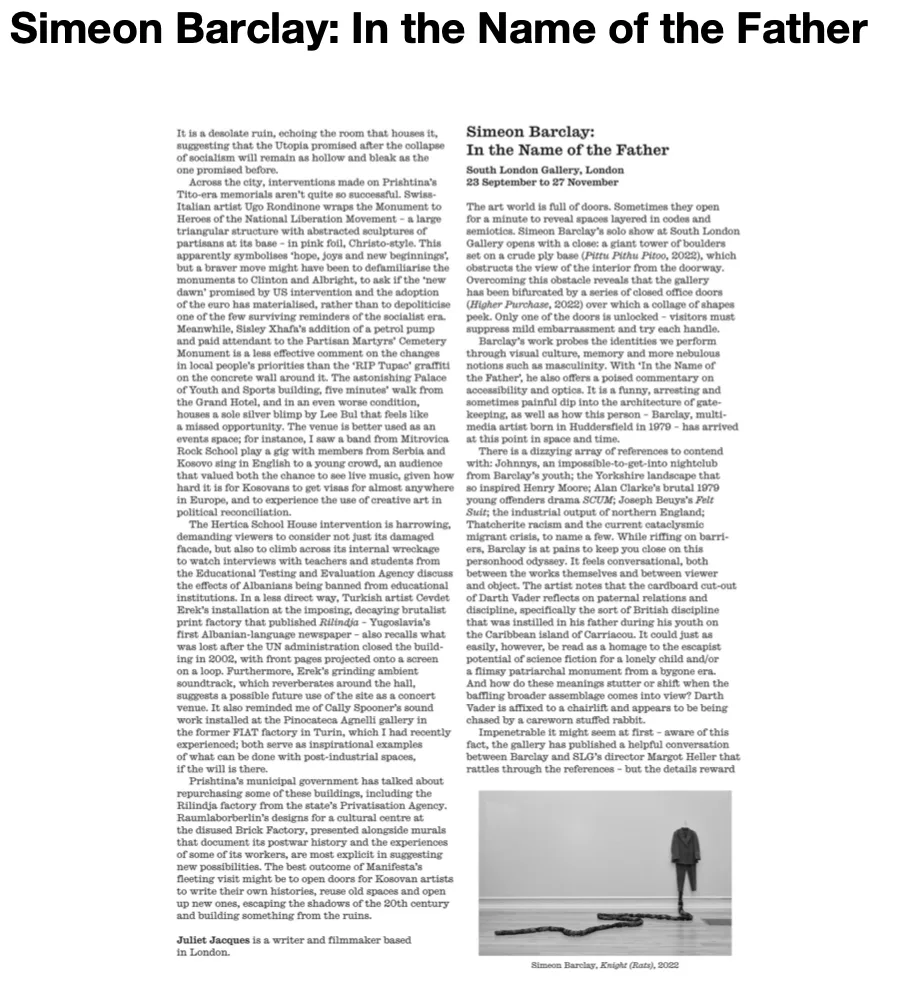
Simeon Barclay: In the Name of the Father
Art Monthly
Art Monthly – Issue 461
‘Simeon Barclay: In the Name of the Father’ November 2022
The art world is full of doors. Sometimes they open for a minute to reveal spaces layered in codes and semiotics. Simeon Barclay's solo show at South London Gallery opens with a close: a giant tower of boulders set on a crude ply base (Pittu Pithu Pitoo, 2022), which obstructs the view of the interior from the doorway.
Overcoming this obstacle reveals that the gallery has been bifurcated by a series of closed office doors (Higher Purchase, 2022) over which a collage of shapes peek. Only one of the doors is unlocked - visitors must suppress mild embarrassment and try each handle.
Barclay's work probes the identities we perform through visual culture, memory and more nebulous notions such as masculinity. With 'In the Name of the Father, he also offers a poised commentary on accessibility and optics. It is a funny, arresting and sometimes painful dip into the architecture of gate-keeping, as well as how this person - Barclay, multimedia artist born in Huddersfield in 1979 - has arrived at this point in space and time.
There is a dizzying array of references to contend with: Johnnys, an impossible-to-get-into nightclub from Barclay's youth; the Yorkshire landscape that so inspired Henry Moore; Alan Clarke's brutal 1979 young offenders drama SCUM; Joseph Beuys's Felt Suit; the industrial output of northern England;
Thatcherite racism and the current cataclysmic migrant crisis, to name a few. While riffing on barri-ers, Barclay is at pains to keep you close on this personhood odyssey. It feels conversational, both between the works themselves and between viewer and object. The artist notes that the cardboard cut-out of Darth Vader reflects on paternal relations and discipline, specifically the sort of British discipline that was instilled in his father during his youth on the Caribbean island of Carriacou. It could just as easily, however, be read as a homage to the escapist potential of science fiction for a lonely child and/or a flimsy patriarchal monument from a bygone era.
And how do these meanings stutter or shift when the baffling broader assemblage comes into view? Darth Vader is affixed to a chairlift and appears to be being chased by a careworn stuffed rabbit.
Impenetrable it might seem at first - aware of this fet, the gallery has published a helpful conversation between Barelay and SIG's director Margot Heller that rattles through the references - but the details reward time spent with them. Authentic Thunderbirds-esque puppets, for example, muddy formal sculptural arrangements: one depicts the artist dressed as Elton John, In turn dressed as Donald Duck, as Elton famously and impractically did at a 1980 Central Park gig (Iceberg, 2022). Simeon/Elton/Donald is imprisoned within a minimalist Perspex cube, sandwiched between two other structures of containment (the show is full of them): a kennel and a chicken coop. Elsewhere, bright blue plastic containers, stacked to evoke Constantin Brancusi's Endiess Column, are the sort typically used to transport food from the UK to the Caribbean because, in the 1980s and 1990s at least, it was cheaper than buying local produce. Barclay's elders would threaten him with entrapment within the barrels, which had the doubling effect of inciting fear and wonder at the idea of a journey to a far-off homeland.
There's a lot of reflection on the things we build and the things we guard entry to. A diptych of paintings
- Portrait in a Landscape, The Yorkshire Rose (Front Elevation) and (Side Elevation), both 2022 - sit quietly amid the installations. The grey panels ripple with small, black holes and pale striations that speak of the perforated steel sheets used to board up vacant properties ready for development, demolition or further disrepair.
The current popularity of 'architectural interventions' in contemporary art suggests a genuine dissatisfaction with the limitations of the white cube and museum. These interventions can feel literally and conceptually flimsy: another frame from which to hang a painting. But Barclay is rigorous in his use of the stage set, less interested in questioning the authenticity of the space and more in establishing prompts that recall a particularly British brand of light entertainment, enjoyable even though, or perhaps because its mechanisms are visible and predictable..
The artist proudly includes both smoke, noisily emitted at intervals in an evocation of the liberating promise of the nightclub, and mirrors.
It is always interesting to see how artists respond to the elegant Victorian expanse of South London Gallery's main space. With its exquisite, suffused light, tall white walls, decorative cornicing and wood floor, the room smacks of British institutional authority.
Barclay has fun with this - stickering the walls and hiding footballs in the eaves. The balls could be a literal nod to the frequently dashed dreams of young people in the post-industrial North, or an allusion to memories of balls lost on roots, games gone awry.
Responding to his current position, Barclay notes:
For years I was mute ... or on mute: voices like mine weren't allowed space in the discourse. Recent institutional shifts, as well as providing great opportunities. can leave you feeling vulnerable, like something larger is at play! This exhibition manages to articulate the orushing complexities of capital - whether cultural eor economic - while injecting some much-needed mischief into proceedings.
Amie Corry is a writer and editor based in London.